How Much Does SaaS Development Cost in 2026?
Get a realistic 2026 cost breakdown, key cost drivers, and practical
budgeting guidance based on real SaaS project experience.
- Introduction
- What Is the Average SaaS Development Cost in 2026?
- Quick Comparison Table
- Detailed SaaS Product Development Cost Breakdown
- Key Factors That Influence SaaS Development Cost
- SaaS Development Cost by Region (US, Europe, Asia Comparison)
- SaaS Pricing Models Explained (And How They Impact Cost)
- How to Price a SaaS Product
- Ongoing SaaS Maintenance and Operational Cost
- Real World SaaS Cost Scenarios
- How to Accurately Estimate Your SaaS Development Cost
- Choosing the Right SaaS Development Partner
- Common Mistakes That Increase SaaS Development Cost
- Final Thoughts: Balancing SaaS Cost, Value, and Growth in 2026
- FAQs
If you want to build a SaaS product in 2026, you are not alone. SaaS is still one of the strongest business models because it scales well, supports subscriptions, and can be delivered entirely online.
Over the past year, our Tech Formation team has delivered SaaS products across fintech, health tech, and B2B automation platforms, and we’ve noticed budgets shifting upward. Not because of trends, but because expectations have changed. Users now expect stronger security, smoother onboarding, deeper integrations, and in many cases, AI-powered features.
One question comes up in almost every conversation: what does it really cost to build a SaaS product that is secure, stable, and ready to grow? Our SaaS application development services answer that through a clear roadmap and cost breakdown.
By the end of this guide, you will understand SaaS development cost in 2026, what impacts it, and how to plan your budget with confidence.

What Is the Average SaaS Development Cost in 2026?
Budgeting for SaaS is similar to buying a house: the cost depends on the scope, complexity, and the level of quality you need from day one. Below is the breakdown we are seeing in the current market.
1. The Basic SaaS MVP Cost
An MVP focuses on testing one core problem for a clearly defined user segment, without overbuilding features that can be tested later.
Cost Range: $15,000 to $40,000
Best for: Early-stage founders validating a SaaS idea quickly.
2. The Standard SaaS Product Cost
This is a production-ready SaaS product with polished dashboards, multiple user roles, core integrations, and a solid billing system.
Cost Range: $40,000 to $99,000
Best for: Startups ready to compete in a real market.
3. Enterprise SaaS Platforms Cost
Enterprise SaaS platforms require advanced security, multi-tenant architecture, scalability planning, and compliance-ready development.
Cost Range: $99,000 to $299,000+
Best for: Corporate-grade products, regulated industries, and enterprise buyers.
Quick Comparison Table:
Here’s a clear comparison of SaaS development types, cost ranges, timelines, and ideal use cases:
| Type | Cost Range | Timeline | Best For |
|---|---|---|---|
| Basic SaaS MVP | $15,000 to $40,000 | 6 to 10 weeks | Idea validation and early launch |
| Standard SaaS Product | $40,000 to $99,000 | 3 to 5 months | Growth-stage SaaS with core features |
| Enterprise SaaS Platform | $99,000 to $299,000+ | 6 to 9 months | Security, compliance, and large-scale delivery |
Detailed SaaS Product Development Cost Breakdown
Many cost guides only share totals. In real SaaS projects, the budget is spread across multiple layers. Here’s how a SaaS product development budget typically breaks down in 2026.
1. UI/UX Design Cost
A strong SaaS UI/UX design approach directly affects onboarding, dashboards, workflows, and usability across roles and screens.
Typical cost range: $3,000 to $20,000+
2. Frontend Development Cost
Frontend includes dashboards, settings, forms, tables, responsive UI, and performance for data-heavy screens.
Typical cost range: $8,000 to $50,000+
3. Backend Development Cost
Backend is usually the largest cost driver: APIs, auth, billing, multi-tenancy, business logic, reporting, and scalability.
Typical cost range: $12,000 to $100,000+
4. DevOps & Cloud Infrastructure Setup
DevOps includes cloud setup, CI/CD, environments, deployments, monitoring basics, and scaling readiness.
Typical cost range: $4,000 to $25,000+
5. Quality Assurance & Testing
QA reduces bugs, rework, and production failures through manual testing, regression testing, and sometimes automation.
Typical cost range: $3,000 to $30,000+
6. Security & Compliance Implementation
Security includes RBAC, encryption, audit logs, tenant isolation, and often SSO for B2B SaaS.
Typical cost range: $5,000 to $40,000+
Key Factors That Influence SaaS Development Cost
Two SaaS products can look almost the same, but the cost can still be very different. That is because the total price depends on what you choose to include.
Product Features and Workflows
If your SaaS only has a login and a simple dashboard, it will cost less. But if you add automation, reports, and many user roles, the cost goes up.
Design and User Experience
In 2026, UI/UX directly impacts retention and conversion. Users form trust decisions within seconds, so clean design, smooth onboarding, and clear navigation are no longer optional. Explore our SaaS-focused UI/UX design services to see how we design for retention and onboarding performance
Multi-Tenant Requirements
If your SaaS is for many companies, you need multi-tenancy. This takes more time because each company’s data must stay separate and secure.
Integrations
Connecting tools like payment gateways, CRMs, email platforms, and analytics tools increases the SaaS cost. Each integration needs setup and testing.
Security and Compliance
Features like MFA, SSO, encryption, audit logs, and access control add cost. But they are very important for enterprise SaaS platforms.
AI Features
AI features also increase cost. They take extra work to build, and they usually have monthly usage costs too.
SaaS Development Cost by Region (US, Europe, Asia Comparison)
SaaS development cost also varies significantly by region. Rates depend on talent availability, experience level, and how mature the local SaaS ecosystem is.
Below are typical hourly ranges in 2026.
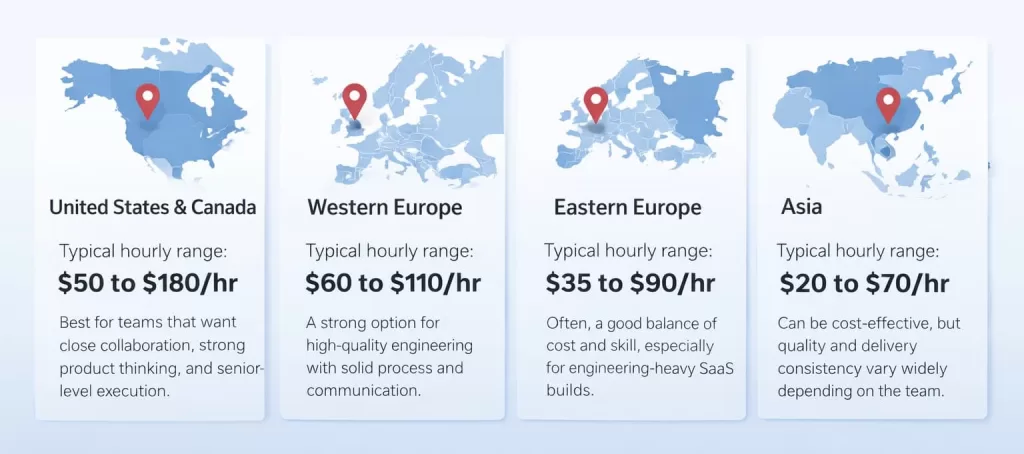
1. United States & Canada
Typical hourly range: $50 to $180/hr
Best for teams that want close collaboration, strong product thinking, and senior-level execution.
2. Western Europe
Typical hourly range: $60 to $110/hr
A strong option for high-quality engineering with solid process and communication.
3. Eastern Europe
Typical hourly range: $35 to $90/hr
Often, a good balance of cost and skill, especially for engineering-heavy SaaS builds.
4. Asia
Typical hourly range: $20 to $70/hr
Can be cost-effective, but quality and delivery consistency vary widely depending on the team.
Note: These are general market ranges. Actual rates vary based on seniority, SaaS experience, tech stack, and whether the team includes product, UI/UX, QA, and DevOps support.
SaaS Pricing Models Explained (And How They Impact Cost)
Many founders think pricing comes after development. But pricing actually changes what you need to build. Your SaaS pricing models can increase or decrease your SaaS development cost.
Here are common software pricing models used in 2026.
Subscription-Based Pricing
Users pay monthly or yearly. This needs billing setup, plan management, and subscription control.
Usage-Based Pricing
Users pay based on usage, like storage, number of users, or API calls. This is popular, but it costs more to build because you need tracking and reports.
Freemium Pricing
Some users get a free plan. But free users still use your system, so SaaS cost management becomes very important.
Per User Pricing
Common for B2B SaaS. This needs user management, team controls, and permissions.
Enterprise SaaS Pricing Models
Enterprise pricing is usually custom. These enterprise SaaS pricing models often need strong security, compliance, onboarding, and integrations.
How to Price a SaaS Product
Pricing should reflect value and operational reality.
We usually guide teams to evaluate customer value, competitor benchmarks, and real infrastructure costs before finalizing pricing. This is where structured SaaS strategy consulting becomes important.
Mapping SaaS Development Cost to Pricing Strategy
Your pricing should support your business for the long term. For example, if your SaaS development cost is $80,000, your pricing must also cover:
- Cloud infrastructure
- Support
- Sales and marketing
- Product updates
- Security and compliance
If your pricing is too low, your SaaS spend grows faster than your revenue.
Before You Finalize Pricing, Validate Your Cost Structure
We help founders map development cost, infrastructure, and pricing into one practical roadmap.

Ongoing SaaS Maintenance and Operational Cost
SaaS development is only the start. The ongoing SaaS cost continues after launch. Your SaaS cost includes:
- Cloud hosting
- Third-party tools
- Monitoring systems
- Support
- AI usage
That is why SaaS cost management matters. Here are useful SaaS cost optimization strategies:
- Use auto scaling so you do not pay for unused servers
- Watch the database and storage growth early
- Use caching to reduce repeated work
- Review third-party subscriptions often
- Limit and track AI usage to stop cost spikes
Good SaaS cost optimization is not about cutting quality. It is about reducing waste and controlling SaaS spend.
Real World SaaS Cost Scenarios
Examples make SaaS development costs easier to understand.
Startup SaaS Example
Problem: A founder wants to launch fast in a niche industry.
Scope: User accounts, dashboard, workflow, payments, email notifications
Timeline: 6 to 10 weeks
B2B Growth SaaS Example
Problem: A SaaS company wants more features and better performance.
Scope: Role-based access, analytics dashboards, integrations, subscription upgrades
Timeline: 3 to 5 months
Enterprise SaaS Platform Example
Problem: A platform for enterprise clients with strict security needs.
Scope: Multi tenancy, SSO, audit logs, compliance, advanced access control, scalability planning.
Timeline: 6 to 9 months
The pattern is simple. The more secure and scalable your SaaS must be, the higher the cost.
How to Accurately Estimate Your SaaS Development Cost
If you want a good estimate, do not guess from random numbers online.
To estimate SaaS development cost, start with clarity.
- Define your MVP features
- List required integrations
- Choose your SaaS pricing models early
- Decide if AI is part of Phase 1
- Create a roadmap for Phase 2
Our Tech Formation team often suggests starting with concept validation and PoC first. This reduces risk and makes the budget more accurate.
Refer to our POC vs Prototype vs MVP for more insights.
Choosing the Right SaaS Development Partner
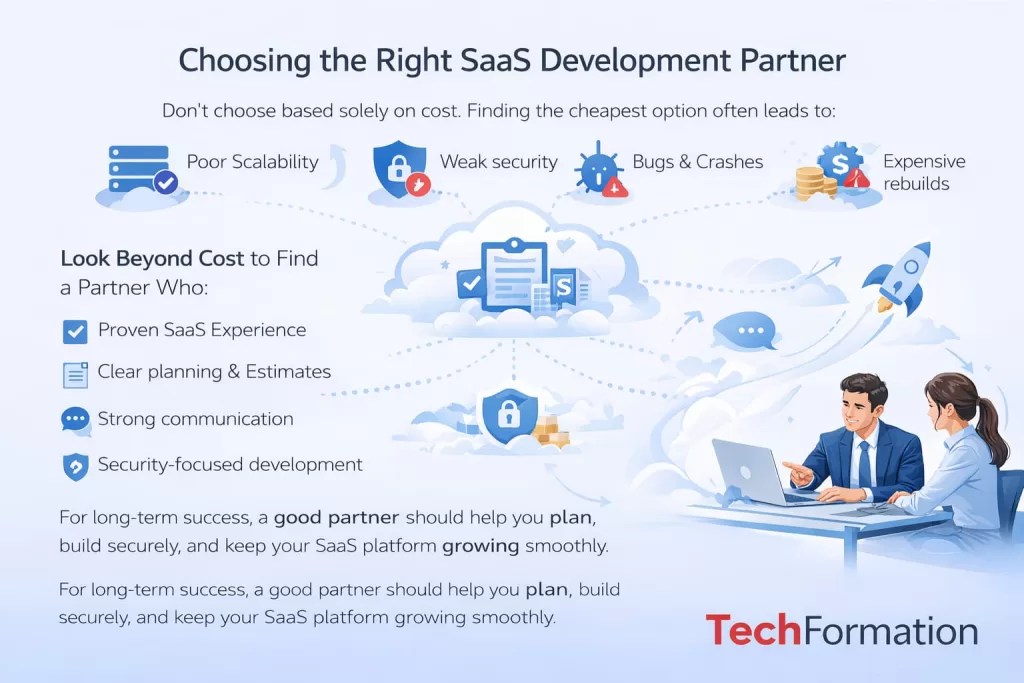
Your SaaS development partner matters a lot. Many teams choose the cheapest quote. Later, they face problems like:
To estimate SaaS development cost, start with clarity.
- Poor scalability
- Weak security
- Bugs and crashes
- Expensive rebuilds
A good partner should do more than code. They should help you plan and reduce long-term SaaS costs. When choosing a partner, look for:
- Proven SaaS delivery experience
- Clear planning and documentation
- Transparent estimates
- Strong communication
- Security-focused development
- Support after launch
We focus on long-term outcomes, not just delivery. Our goal is to help businesses build SaaS platforms that can grow smoothly.
Common Mistakes That Increase SaaS Development Cost
Here are common mistakes we see.
To estimate SaaS development cost, start with clarity.
- Pricing is too low at the start.
- Copying competitors without checking your own SaaS cost.
- Offering too many plans and confusing customers.
- Not controlling AI usage and losing profit.
- Ignoring SaaS cost management and cloud spending.
In 2026, pricing is not only about getting customers. It is also about staying profitable.
Final Thoughts: Balancing SaaS Cost, Value, and Growth in 2026
The SaaS development cost is rising because SaaS standards are rising too. Users now expect software that is fast, secure, easy to use, integration-ready, and increasingly powered by AI.
The goal is not to reduce cost at any price. The goal is to invest in the right areas early so your SaaS can scale without constant rebuilds, performance issues, or expensive rework later.
Cost should support scalability, not limit it. And pricing should reflect real value and operational reality, not guesswork.
If you want a realistic estimate and a clear plan, Tech Formation can help with a structured cost assessment and roadmap.
FAQs
1. What hidden costs are often overlooked in SaaS development?
Most hidden costs appear after launch. This includes cloud hosting, third-party tools, monitoring, security updates, compliance work, AI usage, and ongoing maintenance. These costs grow as usage grows, so it’s important to plan for them early.
2. How do third-party integrations impact SaaS cost?
Integrations increase cost because they require setup, testing, and long-term support. APIs change, authentication expires, and edge cases appear over time, which means integrations are rarely “one-and-done.”
3. Can faster development reduce overall SaaS cost?
Sometimes. A faster build can reduce upfront cost, but rushing often creates technical debt. If quality drops, you usually pay more later through bugs, poor performance, and expensive rebuild work.
4. Should you outsource SaaS development or build an in-house team?
For startups and small teams, outsourcing is often the faster and more cost-effective option. In-house teams make more sense once you have stable funding, a long roadmap, and continuous development needs.
5. How long does it take to recover SaaS development costs?
It depends on your pricing, customer growth, churn, and retention. Many SaaS products recover development costs within 6 to 18 months when pricing and go-to-market execution are strong.
Launch Faster With a Clear Budget and Architecture Plan
Book a consultation and receive a structured cost estimate within 48 hours.

Article by
Rupinder Singh
Team Lead at Tech Formation
Rupinder Singh leads the development team at Tech Formation, offering over 7 years of full-stack experience in designing scalable SaaS solutions, integrating AI-driven technologies, overseeing MVP and proof of concept development to facilitate efficient product innovation and timely market delivery.
Let’s Connect and Create Something Remarkable